
Couch to 5K is a beginner run-walk plan that builds you from very little or no running to completing a 5K in a few weeks.
The idea is simple: don’t try to “become a runner” in one miserable session; start with short run intervals, recover with walking, and let the body adapt.
Rex loves this plan because it does not ask him to become a hero on day one.
It asks him to show up, survive the first few minutes, and stop confusing effort with progress.
Coach Fly likes it because it respects how beginners actually adapt: slowly, repeatedly, and without the dramatic collapse.
Why It Works
Couch to 5K works because beginners usually fail when they start too hard, too fast, and too often.
The source files repeatedly show that the body responds better to manageable effort, consistent recovery, and gradual progression than to random all-out suffering.
That is especially true for tissue adaptation, since calves, tendons, and feet need time to catch up with the lungs.
It also works because the run-walk structure keeps effort under control.
That makes it easier to stay in a sustainable zone, build confidence, and avoid the classic beginner loop of pain, panic, and quitting.
For Rex, that is already a huge upgrade.
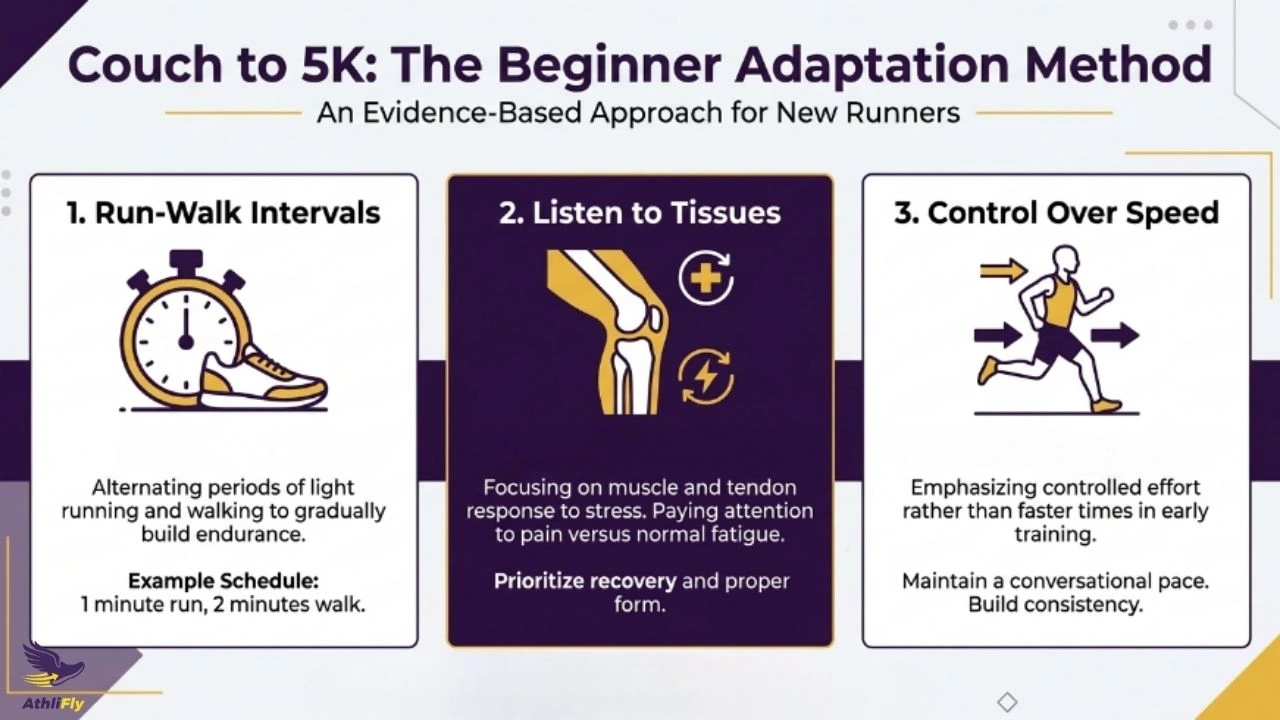
Rex’s First Week
Rex’s first week is not about speed or distance.
It is about learning that running does not have to feel like an emergency.
Coach Fly would rather have Rex finish a boring, controlled session than survive one heroic disaster and need two days to recover.
A good beginner pattern is short run segments separated by walk breaks.
That gives the cardiovascular system work without crushing the legs, which is exactly what a true beginner needs.
It also makes the whole thing feel less like punishment and more like a repeatable habit.
The Hidden Problem
The real reason some Couch to 5K attempts fail is not the plan itself.
It is the beginner trying to race the plan.
Rex hears “beginner run” and immediately starts acting like he is being chased by a tax audit.
That turns an easy session into a high-stress effort, which spikes fatigue and makes every next run feel worse.
Once that happens, the plan stops being a bridge and starts looking like a scam.
That is the exact mistake this article is trying to prevent.
What You Should Expect
The first few runs may feel weird, awkward, or too easy.
That is normal.
In beginner running, “too easy” is often the correct intensity because it lets the body adapt instead of revolt.
You should expect breathing to get better before your legs feel perfect.
You should expect confidence to arrive before speed.
And you should expect the walk breaks to be part of the method, not evidence that you failed it.
Early Rules
Start slower than you think you should.
Use run-walk intervals instead of continuous running.
Leave the session feeling like you could do more.
Rest enough to let your legs adapt.
Ignore the urge to turn every run into a test.
These rules are what keep the plan alive long enough to work.
They are not glamorous, but they are the difference between building a runner and building a story about how running is “not for you.”
Rex has told that story before, and it was a lie.
What Fails Beginners
The plan itself is not the problem.
The problem is when beginners turn it into a race, or skip the walk breaks because they think walking means weakness.
That mistake converts a useful entry plan into a stress test.
AthliFly’s beginner material keeps pointing to the same idea: early running should feel controlled enough to repeat.
If the body never gets a recovery window, the plan becomes a one-time event instead of a habit.
And habits are what make 5K possible, not adrenaline.
Rex’s version of failure is easy to spot.
He goes out too fast, feels embarrassed by how hard it feels, and decides the whole thing is a scam.
Coach Fly calls that a pacing problem, not a personality problem.
What Improvement Looks Like
At first, progress may look small.
You may finish the session without stopping, recover faster between intervals, or find that the same pace feels easier two weeks later.
That is real progress, even if it does not look dramatic in a mirror.
The AthliFly files emphasize that adaptation comes before performance.
Breathing gets calmer first, confidence comes next, and speed usually shows up later.
That is exactly why Couch to 5K can work for people who have never felt athletic in their lives.
Rex does not need evidence that he is talented.
He needs evidence that his body can tolerate a little more than it could last week.
That is the whole game.
Simple Rules for Success
Start slower than you think you need to.
Respect the walk breaks. They are part of the plan, not a bailout.
Stop the session while you still feel like you could continue.
Repeat the same session until it feels normal.
Do not judge the plan by one ugly day.
Those rules are what keep beginners from burning out.
They also keep the ego from hijacking the process.
Rex does not like that part, which is why it works.
FAQ
Is Couch to 5K actually good for complete beginners?
Yes.
It is one of the most practical ways to introduce running because it uses short run-walk intervals and gradual progression instead of sudden hard effort.
That makes it much more realistic for people starting from zero or close to zero.
How long does it take?
Usually several weeks, depending on the exact version of the plan and how often the runner trains.
The key is not speed of completion; it is finishing the plan without getting injured or quitting halfway.
Rex would rather rush, but rushing is usually the mistake.
Do I need to be fit before starting?
No.
That is the point of the program.
It is meant to take an untrained beginner and give them a structured path forward without pretending they already have a runner’s engine.
What if I need to walk more than the plan says?
That is fine.
Walking is not failure; it is part of the adaptation process.
For beginners, the goal is to keep the session controlled enough that you can come back for the next one.
Will it help me lose weight too?
It can, but only if it is paired with sensible eating and consistency.
Running alone is not magic, and eating like Rex after a pizza emergency is not a plan.
The project files repeatedly frame body change as a system of training plus fuel management, not a single workout trick.