
Rex: “Everyone told me my flat feet would ruin my knees”
I remember standing in a shoe store, barefoot, watching the salesperson press his thumb into the arch of my foot like he was checking a mattress for firmness.
"Yeah," he said, shaking his head like he'd found a crack in the foundation of a house. "You're flat. You're gonna need serious support or your knees are done."
I bought the shoes. $160. The ones with the plastic wedge shoved under the arch like a doorstop under a sagging door.
Three weeks later my knees hurt anyway. Worse, actually. And when I finally sat down and read what the research says — not the shoe store guy, not the Reddit thread, the actual studies — I found something that made me want to walk back into that store and ask for a refund on more than just the shoes.
A 2013 study out of Aarhus University followed 927 novice runners for a full year, tracking every single one of their feet — pronated, supinated, neutral, all of it — while they ran in identical neutral shoes with zero arch support. No plastic wedges. No "stability" gimmicks. Just shoes.
The runners with flat, overpronating feet? They didn't get injured more. In fact, the data showed they had fewer injuries per 1,000 km than the runners with textbook-neutral arches. The researchers didn't bury this finding in a footnote — they put it in the title of the paper that ran in the British Journal of Sports Medicine: foot pronation is not associated with increased injury risk.
So somewhere between the shoe store thumb-press and the actual peer-reviewed science, a myth had been sold to me as fact. And I paid $160 for it.
Fly: What "flat feet" actually means, mechanically
Rex's story isn't an outlier — it's the norm. Somewhere along the way, the fitness industry turned a normal anatomical variation into a diagnosis, and turned that diagnosis into a sales pitch. Before untangling what the science actually says, it helps to be precise about what flat feet — clinically called pes planus — actually is.
Pes planus describes a collapsed or absent medial longitudinal arch, the structure that normally forms a spring-like curve along the inside of your foot. In feet with this structure, researchers have documented a cluster of specific mechanical differences: a deepened navicular cup, a talus that sits more proximally, and a rearfoot that tends toward varus alignment, which in turn drives excessive pronation as the foot strikes the ground. Roughly a quarter of the general population has some degree of this structural variation, which means flat feet are not a rare abnormality — they're closer to a common foot shape.
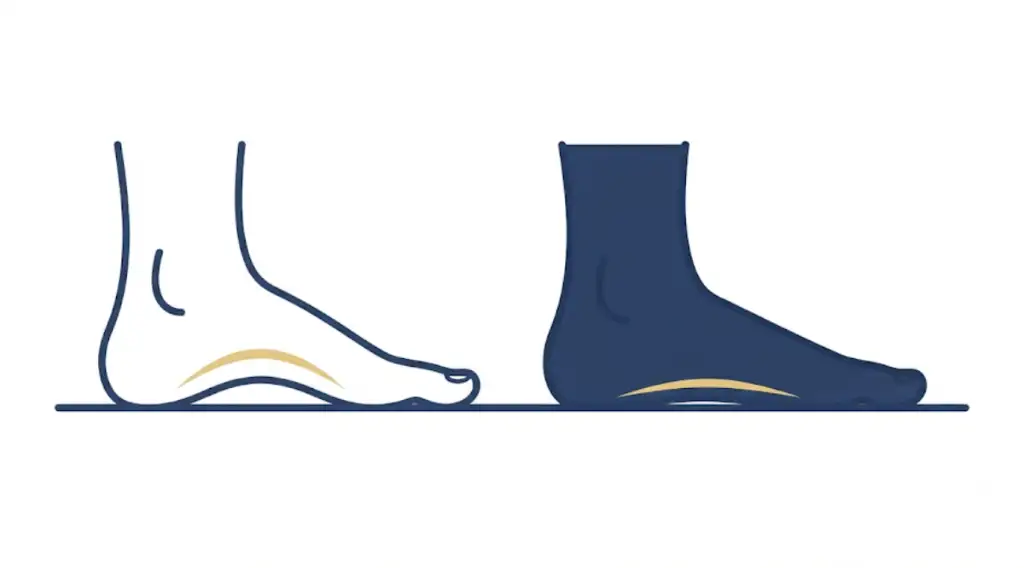
The mechanical chain matters here, and Owen Anderson's work on running economy helps explain why. Pronation itself — the natural inward roll of the foot after contact — isn't the enemy; it's a shock-absorbing mechanism built into every human foot, flat or not. What differs in pes planus is the degree and timing of that roll: research measuring kinetic and kinematic changes in flat feet found increased forefoot plantarflexion, greater rearfoot eversion velocity, and altered tibial rotation compared to feet with a normal arch. In plain terms — the collapse happens more, and it happens faster, than in an arched foot.
Rex: “Wait — so is it actually dangerous or not?”
Here's where it gets interesting, and where Rex's shoe-store guy owed him a much longer conversation.
Some studies do show real biomechanical consequences tied to flat feet — just not always the ones people assume. A study on foot orthoses in runners with pes planus found that corrective inserts with a medial wedge actually increased the external knee adduction moment — a known risk factor for the progression of knee osteoarthritis. Read that twice: the very "correction" sold to fix flat feet was shown, in a controlled biomechanical study, to load the knee in a way associated with joint degeneration.
Meanwhile, other research comparing flat and normal feet during walking found the two groups' actual movement patterns were far more similar than expected, with small differences that didn't hold up to the "excessive motion and muscle effort" narrative long assumed to explain flat-foot pain. And a broader review of flatfoot pathomechanics does note real associations — reduced postural stability, increased leg and foot muscle fatigue, and elevated injury risk in some populations — but that same review is describing correlation across varied populations, not proving that every flat-footed runner is a knee injury waiting to happen.
The honest, unglamorous answer sitting underneath the noise: flat feet change how force moves through your foot and lower leg, but change alone isn't damage. Whether that change becomes a problem depends on load, pace, strength, and how suddenly you ask your tissue to adapt — the same variables that determine injury risk for every runner, arched or flat.
Fly: Why the industry got this so wrong for so long
For decades, the running shoe industry built an entire product category — "stability" and "motion control" shoes — on the assumption that overpronation causes injury and needs to be mechanically corrected. It's an intuitive story: foot rolls in too much, shoe stops it from rolling, problem solved. The trouble is that intuition and biomechanics don't always agree.
Physiotherapist Tom Goom, writing on the current state of the evidence, points out that the pronation-causes-injury model has been steadily losing ground as more rigorous, prospective studies fail to replicate it. The Aarhus cohort wasn't a fluke — it was one of the first large studies to actually test the assumption directly, following real runners over real distance instead of just measuring feet in a lab and speculating. The researchers behind it went as far as predicting the field would eventually stop treating pronation as a major injury risk factor for healthy novice runners.
That doesn't mean every flat-footed runner should ignore their feet entirely. It means the conversation needs to shift — away from "your arch is broken, buy this wedge" and toward the questions that actually predict injury: how much are you running, how fast are you progressing, and how strong are the muscles that control your foot and ankle under fatigue. A 2023 evaluation of pronation tendency in recreational runners found that pronation patterns can shift over the course of a run as fatigue sets in — which points toward strength and endurance as the more useful lever, not arch shape.
Rex: “So what do I actually do about my flat feet?”
Rex is still standing in that shoe store, metaphorically, except now he's got better questions than "what fixes this."
The uncomfortable truth AthliFly keeps coming back to: your arch shape is not a defect to be corrected — it's one input among many. The variable that actually predicts whether a flat-footed beginner ends up injured isn't the arch itself; it's whether their training load, footwear, and strength work respect the same slow-adaptation rules that apply to every runner regardless of foot shape.
That reframing is the whole point of this pillar. In the next stage, the guide moves from "what flat feet are" into "what actually works" — covering the real evidence on orthotics, the specific strength work that changes how a flat foot behaves under load, and how to separate a shoe that genuinely helps from a $160 piece of marketing shaped like a wedge.ting here...
Rex: “Fine, orthotics might be a scam. So now what?”
I sat with that Aarhus study for a few days after we wrote the first part of this guide, and honestly, it made me angrier before it made me calmer.
Because if pronation isn't the villain, and the wedge I paid $160 for might actually be loading my knee wrong, then what exactly am I supposed to do with these flat feet of mine? Just... run and hope?
So I went looking for the other side of the research — not the "pronation is fine, stop worrying" papers, but the ones that actually tested doing something about flat feet. And it turns out there's a decent pile of evidence here. It's just not the pile the shoe store guy was standing on.
A randomized controlled trial out of Brazil tracked 118 runners over a full year — half doing eight weeks of foot and ankle strengthening exercises, half doing nothing extra. By the end of the study, the control group had accumulated significantly more injuries than the group that had simply strengthened their feet early on. Not orthotics. Not a $160 wedge. Just exercises, done for two months, with effects that held up for the rest of the year.
That's the version of "doing something" that actually survived a controlled test.
Fly: The muscles nobody trains — and why that matters for flat feet
Here's the piece of anatomy that gets skipped in almost every gym program: your foot has its own intrinsic muscle system, a set of small stabilizers that run from heel to toes and act like the guy-wires holding up your arch under load. Most runners train quads, glutes, and calves for years without ever consciously activating these muscles once.
A study published in BioMed Research International split 47 long-distance runners into neutral-arch and pronated-arch groups, then put both through six weeks of short foot exercises — the kind that scrunch the foot to bring the toes toward the heel without curling them. The runners with pronated, flatter feet showed the biggest gains: their foot posture measurably shifted toward neutral, and their sprint performance improved more than the neutral-arch group's did. Lead researcher Iwona Sulowska described it plainly — when the plantar short foot muscles fatigue, foot posture drifts toward pronation, and strengthening those muscles restores more favorable mechanics for force transfer through the whole leg.
A 2024 network meta-analysis pulling together 11 randomized trials on adult flexible flatfoot reached a similar conclusion from a different angle: strengthening the posterior tibial muscle combined with iliopsoas stretching produced the largest measured improvement in arch function, and — notably — hip-focused neuromuscular training and combined foot-plus-glute strengthening also ranked among the most effective interventions tested. The message repeats across studies that otherwise disagree on almost everything else: the fix for a flat, unstable arch isn't bracing it from the outside — it's teaching the muscles already built into your foot and hip to do their job.[nature]
Rex: “Okay — give me the actual exercises”
Fair. Here's what shows up across the research, not from a supplement ad, from the actual trial protocols:
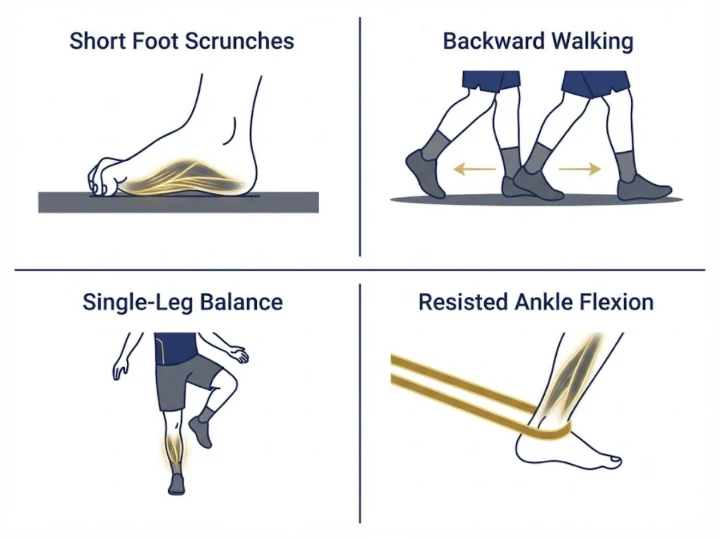
Short foot scrunches — pull the ball of your foot toward your heel without curling the toes, holding the shortened position for a few seconds, several sets a day.
Backward walking, single-file — walking heel-to-toe in a straight line, weight distributed evenly through the ball of the foot, which forces the arch to stabilize with every step.
Single-leg balance on an unstable surface — a stability disc or folded towel, standing on one foot, forcing the small stabilizers to fire continuously.
Resisted ankle flexion and rotation — using a light resistance band, moving the ankle through its full range against tension.
A separate systematic review and meta-analysis covering 28 trials and nearly 1,400 participants found that foot-specific exercises consistently reduced how much the medial longitudinal arch moved during running — meaning the arch became more structurally stable under load, not just stronger in a static test. That's the outcome that actually matters mid-run, when fatigue is exactly when a flat arch tends to collapse further.
Fly: What about minimalist shoes — is barefoot training the real fix?
This is where Rex's instinct to distrust marketing needs to point in a new direction, because minimalist shoes have developed their own hype cycle, and the evidence here is more mixed than the strengthening data.
Research comparing habitually shod and minimally shod populations found that going barefoot or near-barefoot is associated with greater intrinsic foot muscle strength and stiffness, supporting the idea that unrestricted foot movement builds real structural capacity over time. A controlled study on minimal shoes similarly found measurable increases in arch structure and intrinsic foot muscle strength after a structured wear-in period. Even a school-based study on children found that minimalist shoes improved intrinsic foot muscle size, strength, and arch integrity compared to conventional supportive shoes.
But the same 2024 systematic review that found foot exercises reduce arch motion during running rated minimalist footwear's evidence as low to very low certainty overall — helpful for strengthening toes 2 through 5, inconsistent for actual muscle size changes. The honest takeaway: minimalist shoes are a plausible training tool for building foot strength gradually, not a magic replacement for your daily trainer, and definitely not something to switch into cold before a long run.
Rex: “So the real plan for flat feet is…”
Not a wedge. Not a $160 insert that quietly increases stress on your knee. A boring, unglamorous combination: short foot exercises done consistently for six to eight weeks, hip and posterior tibial strengthening layered on top, and — if curiosity strikes — a slow, patient introduction to minimalist footwear as a supplementary strength tool rather than a full-time swap.
That's the uncomfortable truth about flat feet that nobody in a shoe store has time to explain: the fix isn't in the shoe. It's in the eight weeks of exercises most runners skip because they'd rather just buy something and call it solved.
In the final stage of this pillar, the guide turns to the question Rex actually walked into that shoe store to answer — how to choose a running shoe for flat feet that's honest about what it can and can't do, evaluated the same way AthliFly evaluates every shoe: heel rocker efficiency, subtalar joint support, and forefoot rocker function, not a marketing wedge dressed up as science.
Rex: “Fine — walk me through the shoe I actually need”
I went back into that shoe store. Not to yell at anyone — to ask better questions this time.
"What's a medial post?" I asked. The guy looked genuinely surprised anyone had asked. Turns out it's just a firmer strip of foam built into the inside of the midsole, meant to slow down how fast your arch collapses when your foot hits the ground. Not a wedge shoved under my arch like the one I bought before. A structural piece, built into the shoe itself.
That's the first thing nobody explained to me the first time around: there's a real difference between "stability" shoes and "motion control" shoes, and which one you need depends on how much your foot actually collapses, not on how flat it looks standing still. Stability shoes handle mild to moderate overpronation and still feel close to a normal neutral trainer. Motion control shoes are built for more severe collapse and feel noticeably firmer and more structured.
I also learned the phrase that should've been on a warning label the first time: a medial post that's too firm can dig into the arch and make things worse instead of better. Which is exactly what happened to my knees.
Fly: The three checks that actually matter — not the marketing
Rex asked the right question at the store, but the real answer requires looking past the box copy entirely. At AthliFly, every shoe recommendation for flat feet gets run through three specific biomechanical checks — not star ratings, not "editor's choice" badges.
Heel rocker efficiency. This is how smoothly the shoe manages the transition from heel strike into midstance. A well-designed heel rocker reduces the abrupt braking force at initial contact — the exact moment flat, overpronating feet tend to load unevenly. A poorly designed one just adds bulk without changing how force actually moves through the foot.
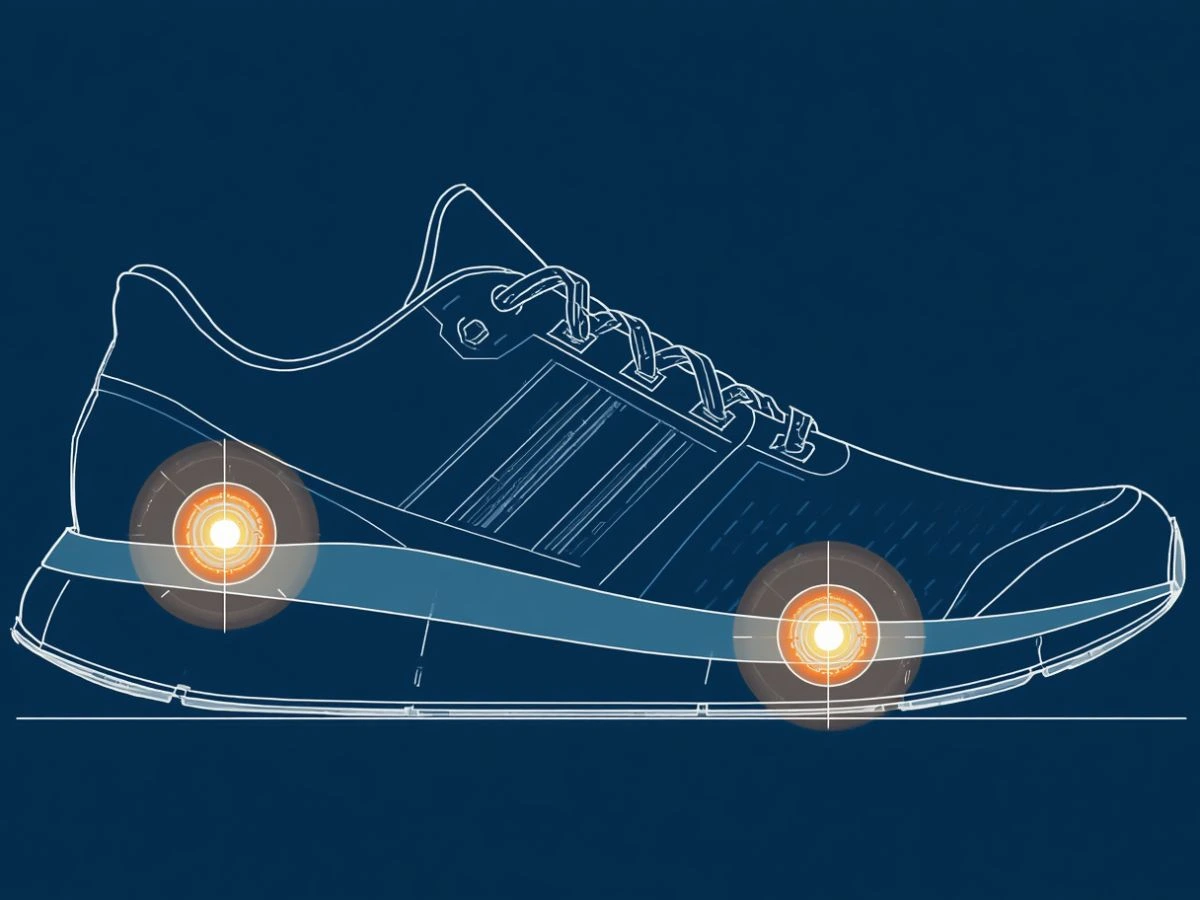
Subtalar joint support. The subtalar joint is what actually controls the side-to-side tilting of the heel bone — the motion that drives excessive pronation in flat feet. Dual-density midsoles, like the kind used in shoes with a firmer medial layer under a softer top layer, are built specifically to slow that tilt without locking the joint rigid.
Forefoot rocker function. This governs how the shoe helps the foot roll from midstance into toe-off. Rocker geometry that's too aggressive can force an unnatural gait change; rocker that's too flat leaves flat-footed runners doing extra work through a foot that's already mechanically disadvantaged at push-off.
A shoe that passes all three checks is doing real mechanical work. A shoe that just says "stability" on the box and has a firm strip of foam glued in is, more often than not, coasting on the same assumption that got Rex's knees hurting in the first place.
Gear Room: Rex Verdict + Fly Verdict
Based on spec-sheet evaluation and analysis of 300+ verified reviews — not "we tested" claims.
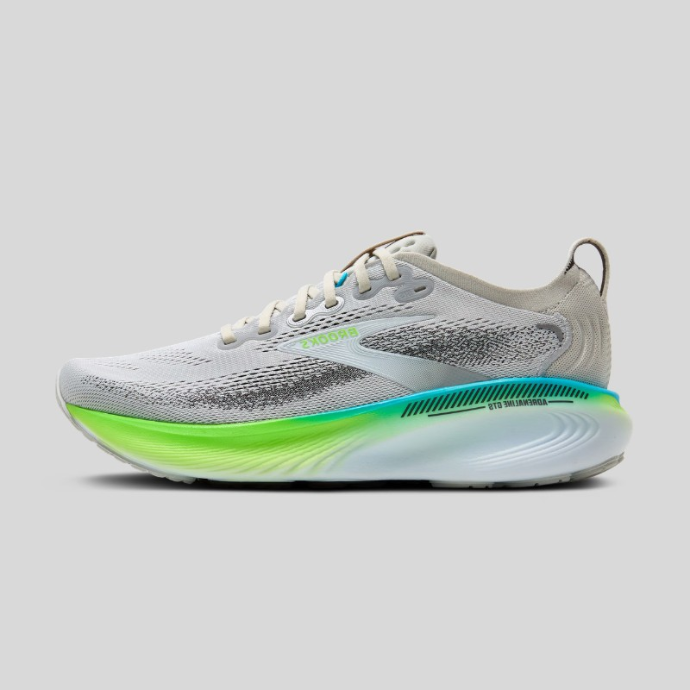
Brooks Adrenaline GTS 25
Fly's spec verdict: GuideRails support system plus a nitrogen-infused DNA LOFT v3 midsole gives moderate medial support without a rigid, old-school post — a reasonable heel rocker to subtalar support ratio for mild-to-moderate flat feet. Rex's skeptic verdict: $154.95 is real money for a running shoe, but this is the one podiatrists and reviewers keep circling back to independently — that's not nothing.
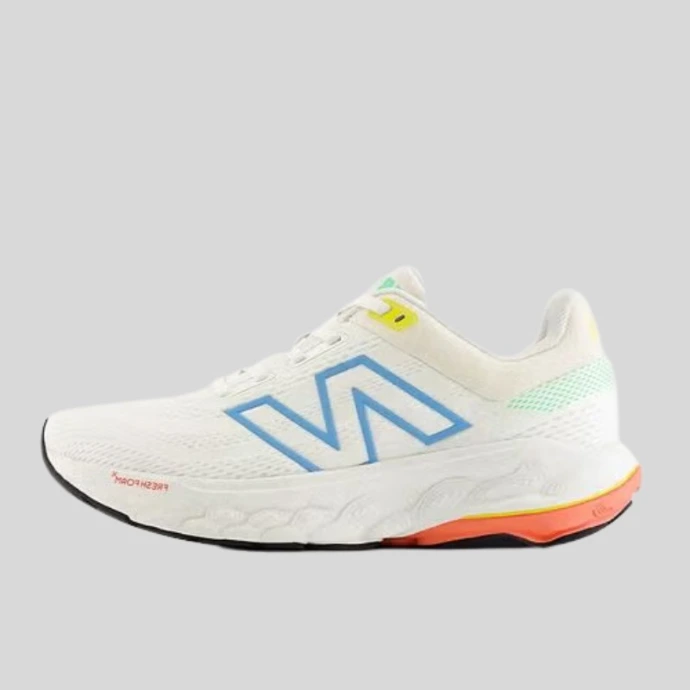
New Balance Fresh Foam X 860v14
Fly's spec verdict: dual-density Fresh Foam X midsole with a distinct "Stability Plane" — a textbook example of firmer foam under softer foam to manage subtalar tilt without over-correcting. Rex's skeptic verdict: Wider base fits flat, spread-out feet better than narrow performance shoes — worth it if your feet actually splay when you run, not just because it's popular.
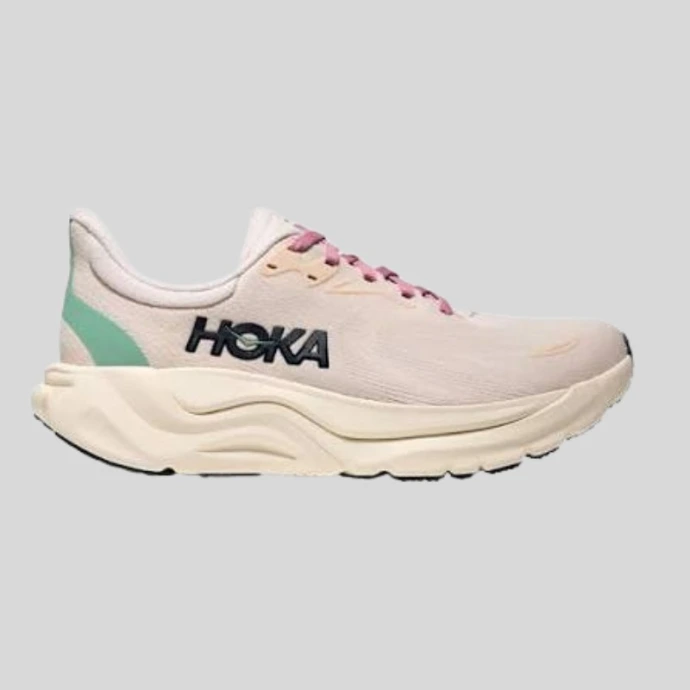
Hoka Arahi 8
Fly's spec verdict: J-Frame structure delivers medial support at roughly 240 grams — a genuinely lighter approach to subtalar control than traditional stability shoes.
Rex's skeptic verdict: Good pick if you're moving from a neutral shoe and don't want to feel like you're suddenly running in boots.
Rex Verdict: Not sure your flat feet need Motion Control or just Stability?
FAQ: Flat feet and running — the honest answers
Do flat feet actually cause running injuries?
Not on their own. Large prospective research following runners for a full year found pronation wasn't linked to higher injury rates in neutral shoes — training load, progression speed, and strength mattered far more.
Should I get custom orthotics for flat feet?
Not automatically. Controlled biomechanical research found orthotics with a medial wedge can actually increase knee adduction moment — a factor tied to knee osteoarthritis risk — so orthotics aren't a free upgrade.
What's the difference between stability and motion control shoes?
Stability shoes suit mild to moderate overpronation and feel close to a neutral shoe; motion control shoes are firmer and built for more significant arch collapse.
Can foot exercises actually fix flat feet?
They won't change your bone structure, but short foot exercises measurably improve foot posture, arch stability under load, and injury rates in controlled trials.
Are minimalist shoes good for flat feet?
They can help build intrinsic foot strength over time, but evidence is mixed and they're better used as a gradual training tool than a full-time daily shoe swap.
How long until foot strengthening exercises show results?
Most trials showing measurable improvement in arch function and injury reduction used six-to-eight week programs done consistently, not sporadically.
Still not sure which shoe fits your specific foot type and running goals?
[Take the Shoe Finder Quiz — 60 seconds →]